On December 27, 2024, tens of thousands of businesses woke up to find their bookkeeping service gone. Bench Accounting shut down abruptly, its website replaced with a closure notice, dashboards dark, books unreachable, four days before year-end. An acquirer surfaced three days later and the service eventually came back, but the original company filed for bankruptcy in January 2025 owing more than $65 million, and customers spent tax season learning how hard it is to leave a service that holds your ledger.
The lesson was not "Bench was badly run." The lesson was structural, and it applies to every outsourced bookkeeping arrangement: when someone else does your books, someone else holds your books. Everything else in this comparison follows from that.
We build DeepLedger, so read this knowing where we stand; as with our Intuit comparison and our look at automation platforms, we've tried to be fair anyway.
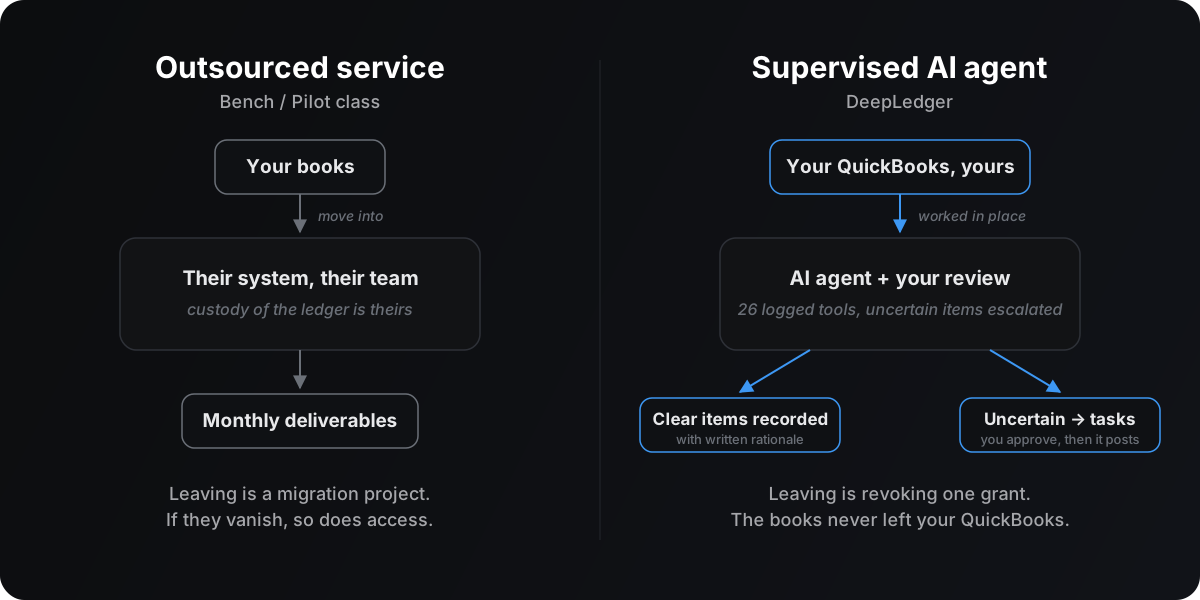
The Short Version
| Outsourced services (Bench/Pilot class) | DeepLedger | |
|---|---|---|
| The model | Their team does your books in their workflow, delivers statements monthly | An AI agent works your books in your QuickBooks; a human approves what it escalates |
| Who holds the ledger | Them, sometimes in proprietary software | You; everything lives in your QuickBooks Online |
| Cadence | Monthly deliverables, questions by email or portal | Continuous; ask anything, any time, answered from the live ledger |
| Who does the judgment calls | Their bookkeepers, applying notes you sent | You or your reviewer, on escalated tasks carrying the agent's reasoning |
| Visibility | Finished statements; the work happens out of sight | A written rationale on every action, in a worklog you can read |
| Continuity risk | The Bench scenario: their outage is your outage | None to inherit; revoking DeepLedger leaves your books exactly where they were |
| Pricing shape | Several hundred to a few thousand dollars a month, sized to volume | $20/mo per company + your Claude/ChatGPT plan, or hosted Agent at $150/mo per company |
| The exit | A migration project: export, rebuild, re-onboard | Revoke one OAuth grant; the books never moved |
What You're Buying From a Service
Be fair to the model first. An outsourced service sells the thing many owners actually want: not doing bookkeeping at all. Send them your feeds and receipts, and finished statements arrive monthly. There are humans applying judgment, someone to email, a contract with a company that will still exist next quarter (usually), and no software for you to learn. For an owner who will genuinely never look at the books between tax filings, that is a real product honestly delivered, and the good services deliver it well.
The costs are also real, and they're not mainly the price tag. They're structural:
The cadence is theirs. Your books are as current as the last delivery cycle. A question in the second week of the month gets answered from last month's close. Mid-month decisions (can I afford this hire, why did margin dip) run on stale numbers or wait.
The judgment is theirs, applied blind. A bookkeeper who has never been inside your business categorizes from patterns and the notes you remembered to send. Corrections go into a ticket, maybe into next month's work.
And custody is theirs. This is the one Bench made vivid. Your ledger lives in their system, in Bench's case proprietary software that couldn't simply be handed to another provider, so leaving on your terms is a migration project, and leaving on their terms (a shutdown, an acquisition, a price change) is a scramble. Even in the happy case, at every moment the availability of your own financial records depends on a vendor's uptime, solvency, and goodwill.
The Other Way: The Books Never Leave
DeepLedger inverts the custody arrangement instead of renegotiating it. Your books stay in your QuickBooks Online. What you add is a worker inside them: an AI agent, connected through a hosted MCP server that exposes your QuickBooks as 26 structured, permissioned, logged tools, plus a portal where the human half happens: a shared task list, a month-end close you sign, and a per-client memory you can read and edit.
The daily loop: the agent pulls your bank feed, checks each transaction against your QuickBooks history and its written memory of your policies, records the clear items (duplicate checks first, rationale logged), and escalates anything uncertain as a task carrying its proposed treatment, its confidence, and its evidence. You approve, correct, or reject; corrections become policy it applies from the next transaction on. Prefer not to drive it yourself? The hosted DeepLedger Agent runs the same loop on a schedule, with the same review gate. Either way it is your AI assistant doing data entry under supervision, not a stranger doing judgment out of sight.
The Differences That Decide It
Custody, and what an exit costs. With a service, the exit is the moment you discover what you actually had: exports, a rebuild, re-onboarding somewhere new, and if the exit wasn't your idea, all of that under deadline. With DeepLedger there is nothing to take back. Cancel, revoke the OAuth grant, and your QuickBooks contains everything the agent ever did, plus two audit trails documenting all of it. We think tools handling your financial records should have to earn trust monthly precisely because leaving is cheap.
Current books versus delivered books. A service closes your month after it ends. An agent works the feed continuously, so "what's my cash position" and "why is margin down" are questions for right now, answered from the live ledger, not from the last deliverable.
Where judgment lives. A service's bookkeeper decides and you find out at month-end. The agent decides only what's clear-cut against your documented policies, and brings everything else to you with reasoning attached. That is more involvement than a service asks of you, and that's the honest trade: ten minutes of reviewing escalations replaces zero minutes of blind trust.
Compounding versus tickets. Correct a service and you've filed feedback. Correct the agent and the correction is written to memory as policy, in plain text you can inspect and edit. The vendor that was miscoded in March is coded right in April, and the escalation list gets quieter every month.
Price. Services price like payroll because they are payroll: several hundred to a few thousand a month, sized to your volume. DeepLedger is $20/month per company plus the Claude or ChatGPT plan you likely already have (first month free, no credit card), or $150/month per company for the hosted always-on Agent. For a practice running many client companies, the math changes what a book of business can carry.
When an Outsourced Service Is the Right Choice
Honest answer: when "I never want to see the books" is a hard requirement and you've priced in the custody risk. If nobody on your side will review even a short escalation list, if you want human judgment applied without your involvement, and if you value having a firm to call (and, candidly, to blame), the service model is built for you. Complex situations that need ongoing professional judgment (multi-entity structures, heavy inventory, accrual work you don't want to think about) can also genuinely warrant humans in the loop every month. If you go that way after 2024, ask the Bench questions first: Whose software do my books live in? What exactly do I get on the day I leave? How fast?
When DeepLedger Is the Right Choice
If Bench's collapse made you flinch, that instinct is worth trusting. If your books should live in your QuickBooks, stay current daily instead of monthly, and cost tens rather than hundreds of dollars a month, and you can spend a few minutes a day approving what the agent wasn't sure about, then the supervised-agent model gives you what the service promised (the bookkeeping, done) without the part it never advertised (the custody, theirs).
Frequently Asked Questions
Is DeepLedger an outsourced bookkeeping service? No. Nobody at DeepLedger touches your books. It is the tool layer and review workflow between your QuickBooks Online and the AI assistant you bring; the work happens in your ledger, under your supervision.
What happens to my books if DeepLedger disappears? Nothing. Your books are in your QuickBooks Online, where they always were, along with everything the agent recorded and QuickBooks' native audit log. That is the point of the architecture.
Can I migrate from Bench or Pilot to DeepLedger? If your books are already in QuickBooks Online, connect and start; the agent works with your existing history. Coming from a proprietary ledger, you'll first import your records into QuickBooks (a service-exit step any destination requires), and the agent can then help clean up and reconcile what came over.
Does the AI post entries without approval? Clear-cut items matching your documented policies are recorded with a written rationale in the worklog. Anything uncertain posts only after a human approves the task. Adjusting entries always require approval, and only you can sign a close.
How long does setup take?
Two steps: connect QuickBooks with Intuit's official OAuth, then paste https://mcp.deepledger.ai/mcp into Claude, ChatGPT, or another client.
DeepLedger puts a supervised AI agent inside your own QuickBooks Online: current books, visible reasoning, human approval on anything uncertain, and an exit that costs one click. The first month is free, no credit card required.
Try DeepLedger with your QuickBooks account or see how the whole system works.