 DeepLedger
Connect ChatGPT to QuickBooks Online by adding DeepLedger as a custom MCP connection. Connect your company in DeepLedger, enable Developer mode in ChatGPT, and add https://mcp.deepledger.ai/mcp. Your AI agent can then record transactions, retrieve reports, and work with you on tasks and month-end close.
Using QuickBooks Desktop? This Online connection does not read Desktop company files. See QuickBooks Desktop with ChatGPT and Claude for the separate MCP requirements, an exported-report workflow and our Desktop waitlist.
What you can do after connecting
Through DeepLedger, you can ask your AI agent to:
- Record purchases: bills, expenses, bill payments, and vendor credits.
- Manage sales records: estimates, invoices, customer payments, sales receipts, customer credits, and refund receipts.
- Record other transactions: bank deposits, transfers between accounts, and journal entries.
- Run reports: profit and loss, balance sheet, cash flow, accounts receivable and payable aging, general ledger, and trial balance.
- Prepare month-end close: track close checks, flag issues, assemble financial statements, and propose adjusting entries in DeepLedger's Close Sheet. You review the work and sign off in the portal.
- Work through tasks: raise questions, request missing documents, hand work between you and the AI agent, and track resolution in DeepLedger's Tasks.
- Find supporting information: look up customers, vendors, accounts, transactions, connected bank-feed entries, and uploaded documents.
Before you start
- DeepLedger: an account with access to your company.
- QuickBooks Online: open DeepLedger Settings → Company and QBO Connect, find your company under Companies, choose Connect QB and complete Intuit authorization. Keep an existing connection if it is already active.
- ChatGPT on the web: access to Developer mode. Check OpenAI's supported plans and workspace requirements.
Step 1: Enable Developer mode and open Plugins
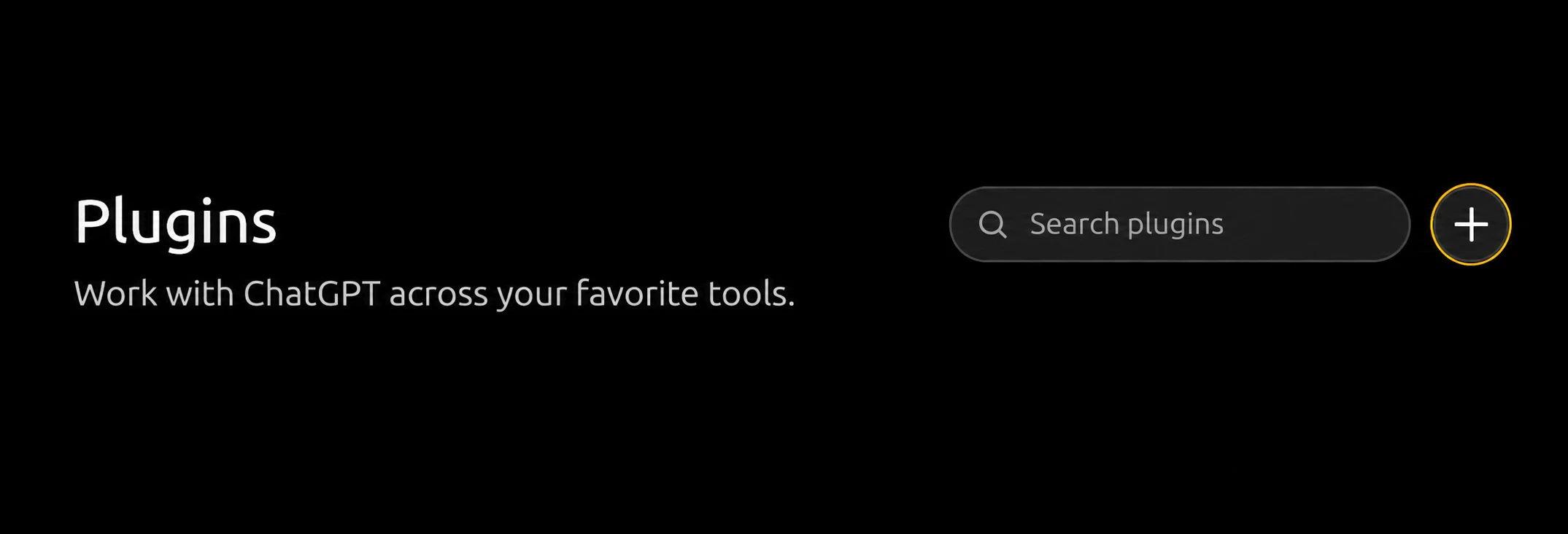
Open ChatGPT Settings → Security and login and turn on Developer mode. Go to Plugins and select + beside the search field. These are the steps in OpenAI's current connection guide.
Screenshots captured September 15, 2026, edited to focus on the relevant controls and remove private details. Select any image to enlarge it.
Step 2: Enter the DeepLedger connection details
In New Plugin, use:
| Field | Value |
|---|---|
| Name | DeepLedger Quickbooks Integration, or your own recognizable name |
| Description | Optional; for example, QuickBooks bookkeeping and reports |
| Connection | Server URL |
| Server URL | https://mcp.deepledger.ai/mcp |
| Authentication | OAuth |
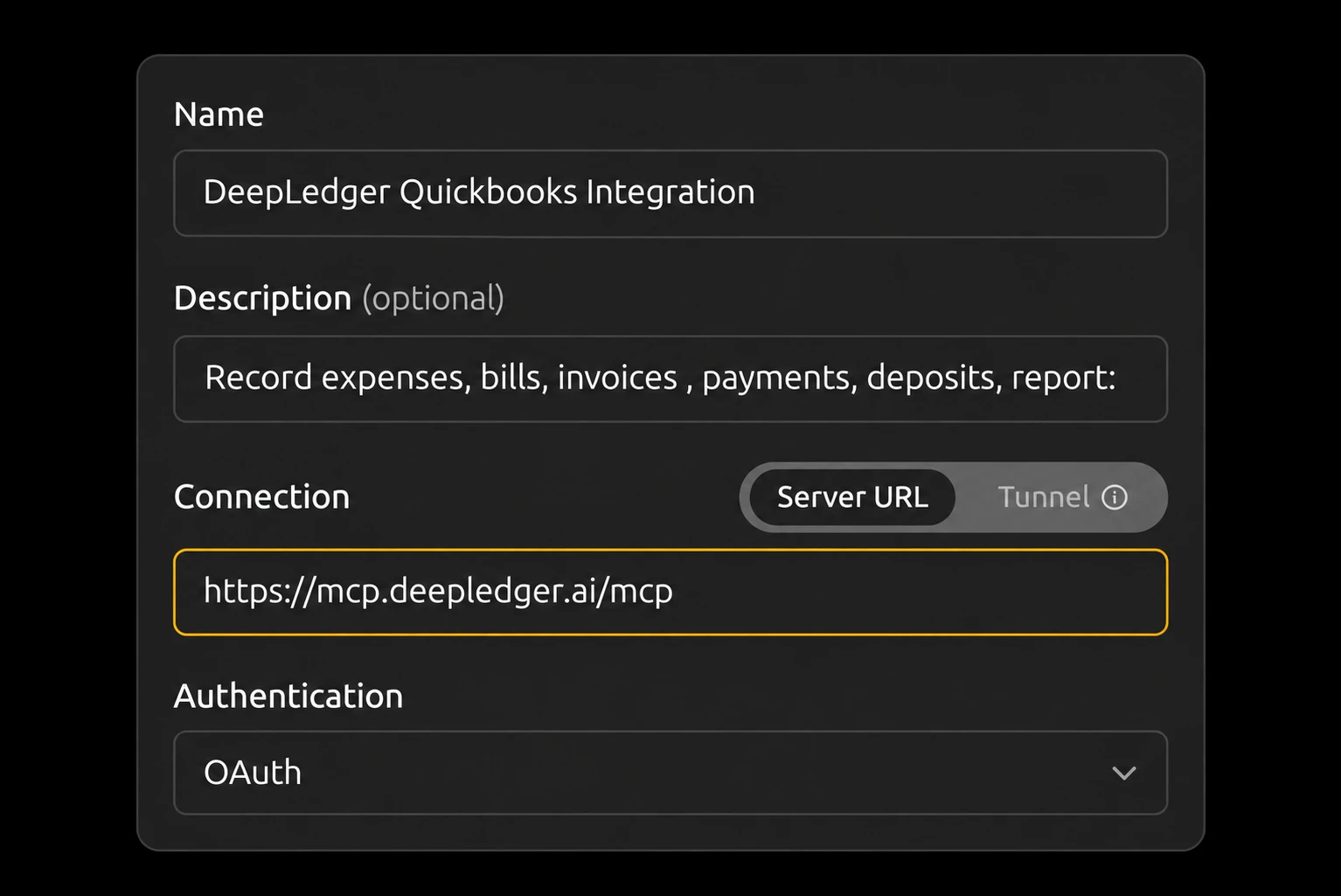
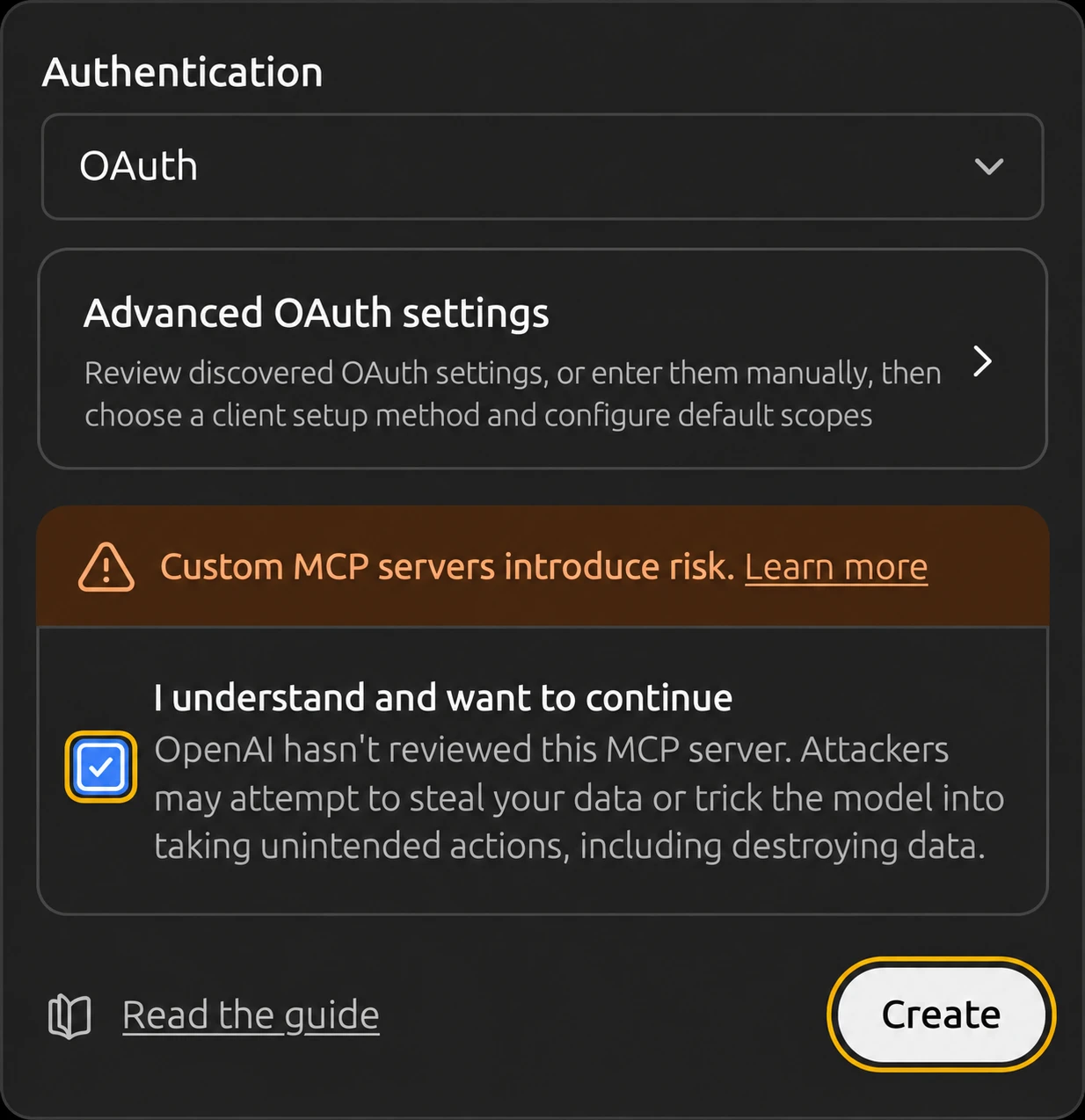
Leave Advanced OAuth settings at their detected defaults. Read the custom-server notice, select I understand and want to continue, then Create.
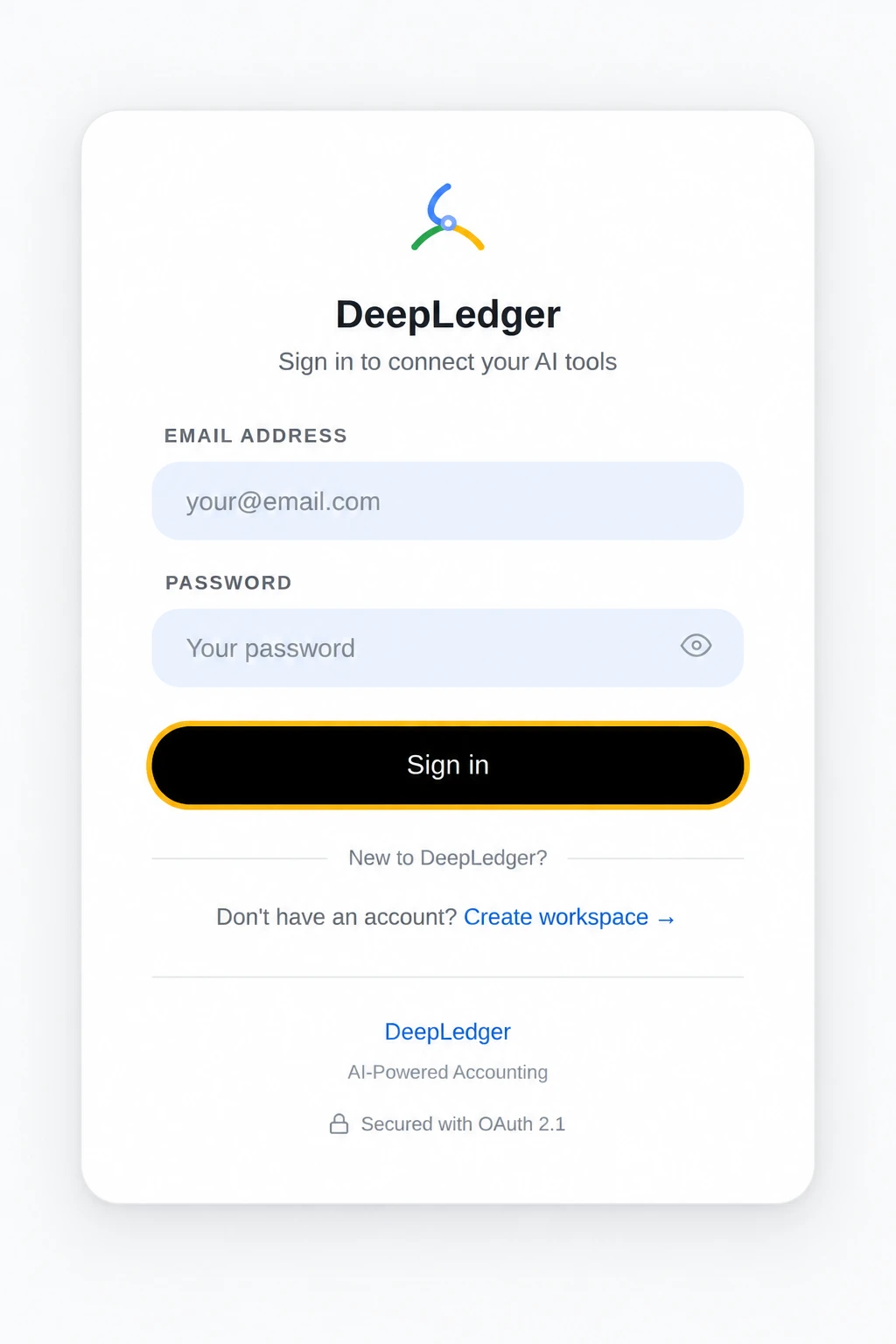
Step 3: Sign in to DeepLedger
When prompted, sign in with the DeepLedger account that has access to your company, then return to ChatGPT. No manually copied API key or local server is needed.
Step 4: Review permissions and start a conversation
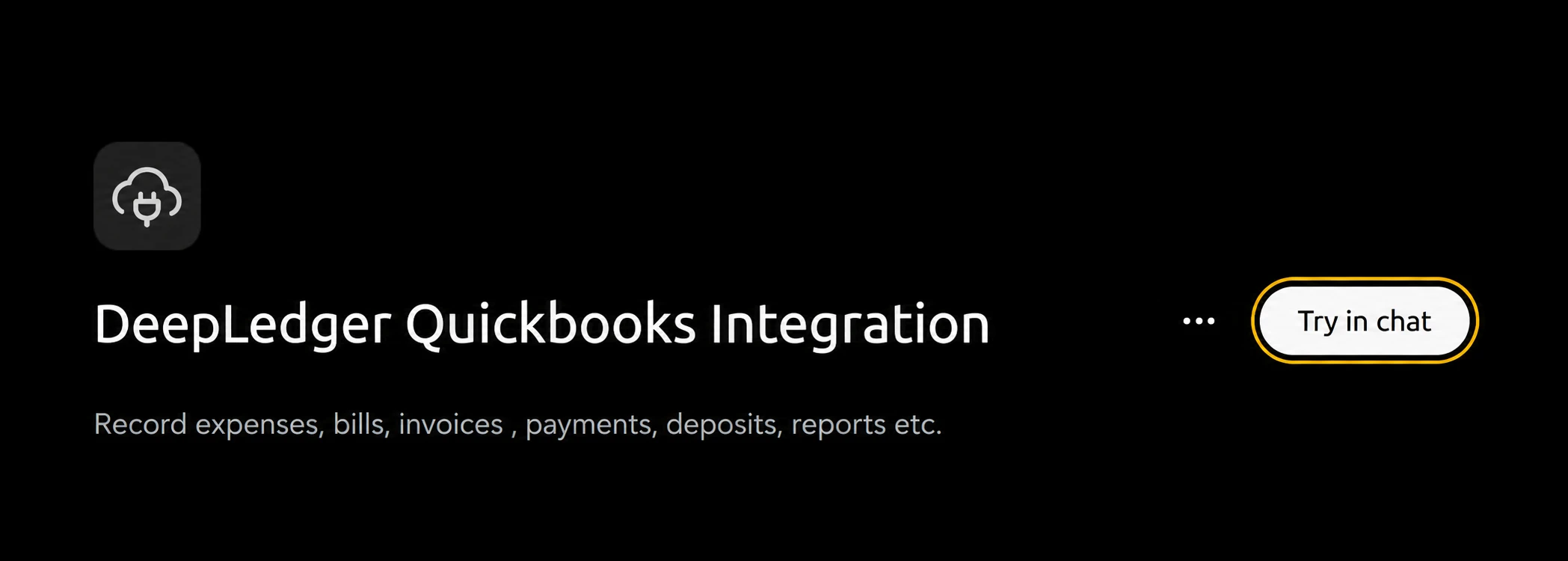
After creation, the DeepLedger plugin page shows Try in chat.
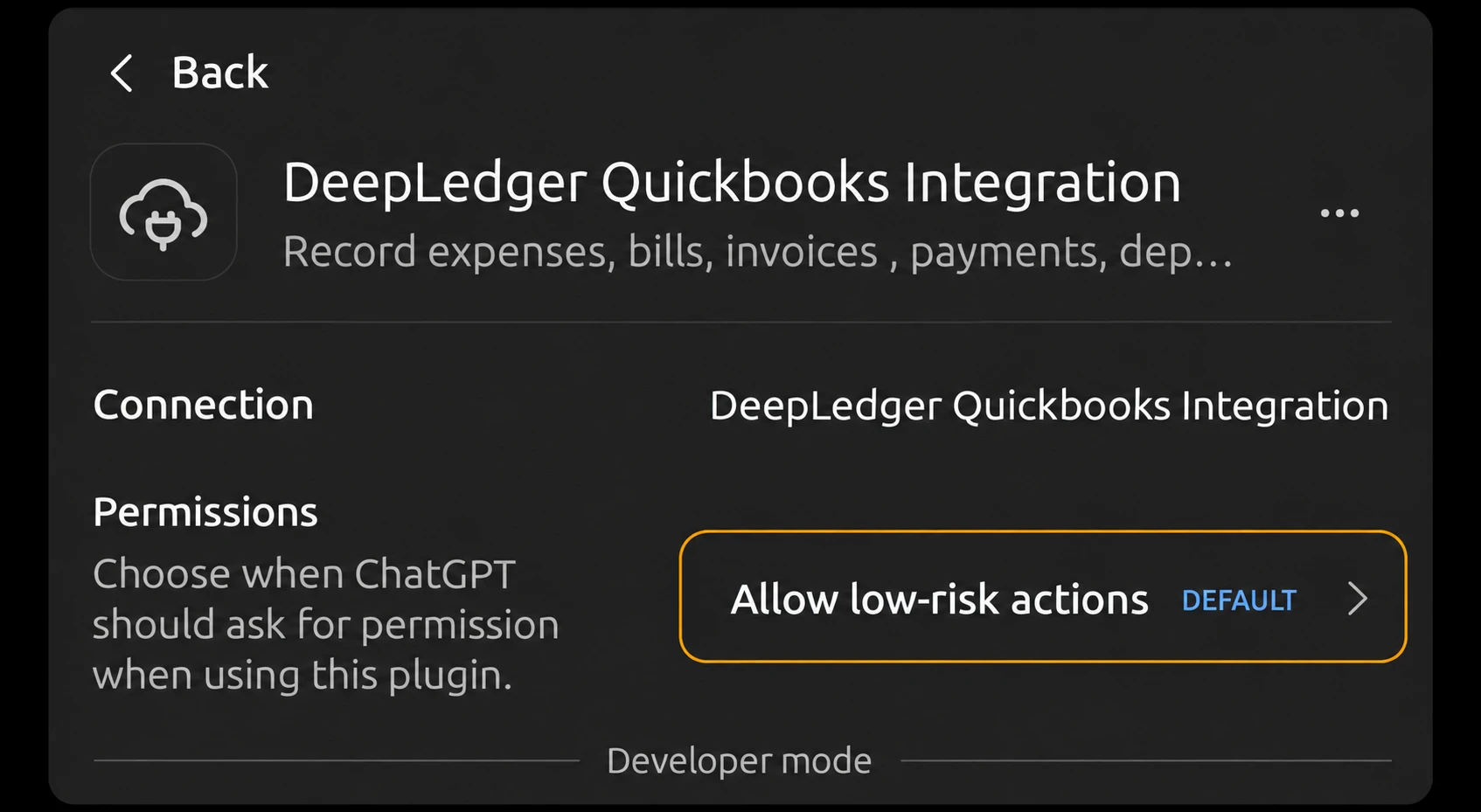
In Settings → Plugins, open your DeepLedger connection and review Permissions and the available actions. The captured account shows Allow low-risk actions; your selection controls when ChatGPT asks for permission.
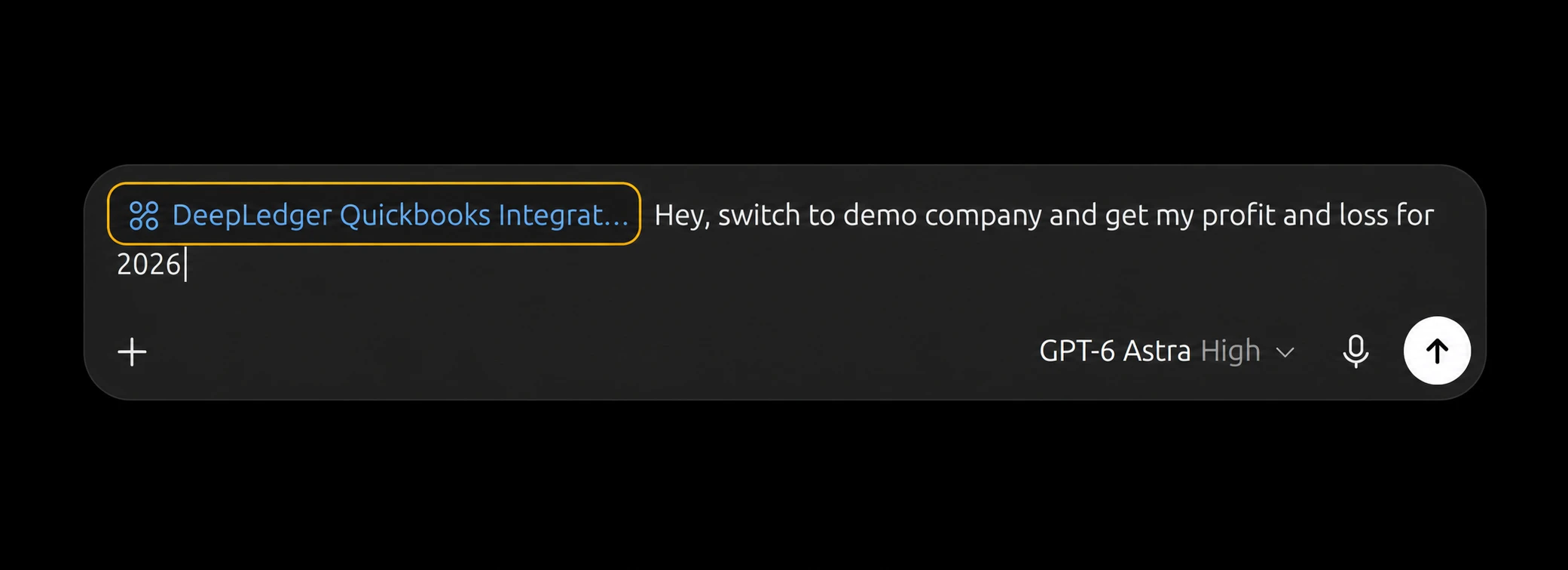
Select Try in chat. In an existing conversation, use + → Developer mode and select DeepLedger if needed. Confirm that DeepLedger is selected before sending your request.
Step 5: Verify the company, then record a real transaction
First check that ChatGPT can reach the intended company and retrieve its data:
Use DeepLedger to show the active QuickBooks company and home currency.
If it is not [company], list the companies I can access and ask which
to use. Do not change any accounting records.

For [company], retrieve the Profit and Loss for [start date] through
[end date] on the [cash or accrual] basis. Show the company, currency,
dates, basis and totals so I can compare them with QuickBooks.
Compare the result with the same report in QuickBooks. If the company is wrong, resolve that before continuing; see working with multiple QuickBooks companies.
For your first write, choose a real receipt or invoice that needs recording. Do not create a made-up expense in your business books just to test the connection. If you are practicing, use a designated demo company.
Attach the document and use the paid-expense or unpaid-bill prompt below. After approving the proposal, check the returned QuickBooks transaction ID and open the saved record. Compare its company, date, amount, category and payment status with the document. If the agent cannot confirm a required detail, resolve it before saving.
A report request leaves the books unchanged, but does not remove write permissions from the connection. Review those permissions separately in ChatGPT.
Next step: verify one company and one report
In DeepLedger Settings → Company and QBO Connect, find the intended company under Companies. If it is not connected, choose Connect QB and have an authorized person complete Intuit sign-in. Start with a demo company when testing a new AI provider; do not send private business reports until your organization has approved that provider and its data settings.
With DeepLedger enabled in your AI client, ask:
Using DeepLedger, list the companies I can access and identify the active company. Ask me which company to use. After I choose, select it and confirm its name and company identifier. Do not create or change accounting records.
Company selection can persist across your connected AI clients. Confirm it again when changing sessions; a company-bound credential may not allow switching. See selecting the right QuickBooks company.
Then replace the bracketed name with that confirmed company:
Using DeepLedger for [confirmed company], retrieve the profit and loss for September 1 through September 30, 2026, on an accrual basis. Show the returned company name and identifier, exact dates, accounting basis, currency, income, expenses and net income. Do not create or change accounting records. If the company or report settings cannot be confirmed, stop and explain the missing information.
In QuickBooks Online → Reports → Profit and Loss, run the report for the same company, September 1–30, 2026, accrual basis, currency and filters. Compare income, expenses and net income, then investigate any differing account lines. A successful tool response includes report data and matching context; a “connected” badge or an AI summary alone is not verification. If totals differ, correct the context and rerun before relying on the result. Follow the P&L analysis and verification workflow.
A read-only prompt is not read-only permissions. The connection can expose write tools; review permissions and proposed actions. After the report agrees, choose a real task from the journal-entry review workflow or overdue-invoice workflow, adapting the client-specific steps to your AI app.
Example prompts to try next
Replace the bracketed details with your own company, dates and account names. The write prompts follow a propose → confirm → record pattern. A request to wait for confirmation is an instruction to the agent, not a claim that every tool has a separate approval screen.
Record a paid expense
Using DeepLedger for [company], record a [currency and amount] software subscription paid to [vendor] on [date] from [bank or credit card account], categorized to [expense account]. Check for an existing transaction and show me the proposed entry before saving. After I confirm, record it and return the QuickBooks transaction reference.
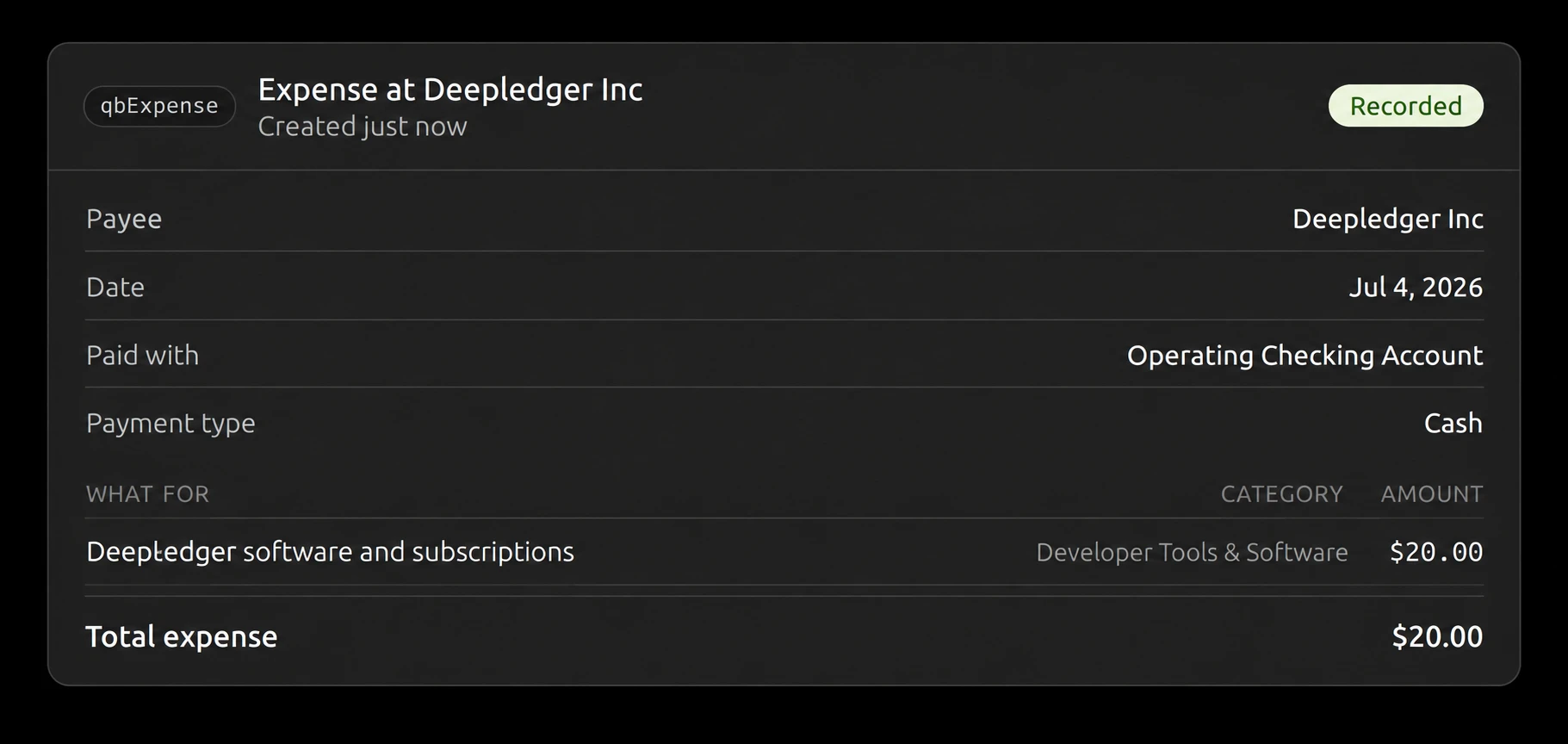
The supplied demo session also shows a completed $20 subscription expense:
Record an unpaid bill
Using DeepLedger for [company], prepare an unpaid bill from this attached vendor invoice. Check for duplicates, use the invoice number, date, due date, line amounts and taxes, and propose the expense categories. Ask me for missing details and show the bill for confirmation before recording it.
Run financial reports
Using DeepLedger for [company], get the profit and loss for [start date] through [end date] and the balance sheet as of [end date], using [cash or accrual] basis. Show the company, dates, currency and report totals, then summarize the main changes from the previous period.
Post a journal entry from an approved schedule
Using DeepLedger for [company], prepare a journal entry dated [date] from this approved schedule. Check the account mapping and whether the amounts are already recorded. Show every debit and credit line, descriptions and tracking details. After I approve, post the entry once and return the saved QuickBooks ID and lines for comparison.
AI can post complex, multi-line entries through the connection. The journal-entry walkthrough includes a six-line accrual example, verification steps and the fields the current tool supports.
Save and reuse a custom report
In DeepLedger for [company], save a custom report called "Monthly business review": last month's accrual profit and loss compared with the prior month, plus the balance sheet as of last month-end. Include instructions to highlight the largest changes in income and expenses. Run it now.
Next time:
Using DeepLedger for [company], run my saved "Monthly business review" for [start date] through [end date].
The custom report definition is saved in DeepLedger and retrieves current QuickBooks data each time you run it.
Troubleshooting the connection
Developer mode or the + control is missing
Check the linked OpenAI eligibility requirements and your workspace policy. A workspace administrator may need to enable access.
Sign-in does not finish
Confirm you can sign in to DeepLedger and access your company. Check the complete server URL and OAuth selection, then retry authorization.
Connected, but no tools are used
Select DeepLedger in a fresh conversation and explicitly ask it to list your companies. If a tool is missing, open the connection in Plugins, choose Refresh, then start a new conversation.
The wrong company appears or QuickBooks requests fail
List and switch to the intended company. If its Intuit authorization has expired, use Reconnect QB under DeepLedger Settings → Company and QBO Connect. Recreating the ChatGPT connection will not repair that separate authorization. If an older connection says it is fixed to one company, reconnect DeepLedger in ChatGPT to enable switching.
More help: QuickBooks troubleshooting guides.
Frequently asked questions
How do I connect ChatGPT to QuickBooks Online?
Connect your company in DeepLedger, enable Developer mode in ChatGPT, and add https://mcp.deepledger.ai/mcp from Plugins. Sign in, select DeepLedger in your conversation and verify the company with a dated report. For your first write, use a real document, approve the proposed entry and check the saved QuickBooks record.
Which ChatGPT plans support this DeepLedger setup?
OpenAI lists web Developer mode for Plus, Pro, Business, Enterprise and Education accounts. Workspace policy can restrict access; check the linked OpenAI requirements before changing plans.
Can ChatGPT actually record transactions in QuickBooks, or only read data?
The DeepLedger connection supports both reports and bookkeeping writes, including expenses, bills, invoices and journal entries. The demo expense above shows a recorded transaction. The example prompts ask for confirmation before saving.
Is it safe to give ChatGPT access to my books?
You authorize QuickBooks through Intuit and sign in to DeepLedger separately. Review the connection's permissions and each service's data terms. A request for a report does not make the connection read-only.
Can ChatGPT categorize my bank transactions?
Your AI agent can review bank-feed entries connected or imported into DeepLedger and propose categories using QuickBooks history and company policies. Connecting QuickBooks alone does not populate DeepLedger's Bank Feed.
How do I disconnect ChatGPT from QuickBooks?
Remove the DeepLedger connection from ChatGPT's Plugins settings. To disconnect the underlying QuickBooks company, a DeepLedger owner or admin can use its Disconnect action in Settings > Company and QBO Connect. That affects other workflows using the same company connection.
Create a DeepLedger account to get started. Related: Claude setup, Intuit Enterprise Suite, uncategorized transaction cleanup, and the QuickBooks MCP guide. Explore all AI platforms and integrations.