"Tipping point" is a phrase vendors reach for every January. What makes 2026 different is who said it: CPA Trendlines opened the year declaring that agentic AI has reached the tipping point in tax and accounting firms, and by July it was covering firms racing to tame AI before AI outruns the practice. The trade press for practitioners, not software companies, is the one calling it.
We build agent tooling for QuickBooks, so we are not neutral observers. But the claim deserves scrutiny rather than applause, so this post does three things: pins down what "agentic" actually means past the buzzword, walks through the eighteen months of infrastructure that made it real, and looks honestly at what the numbers do and do not show, ending with what a small firm should actually do about it this year.
What "Agentic" Means, Precisely
The word gets used loosely enough to mean nothing, so here is the working definition. An assistant answers: you ask how to book a customer deposit that includes a refund, it explains, and you go do it. An agent executes: you say "work the bank feed," and it fetches the transactions, checks each against history and your policies, records the ones it can defend, and flags the rest to a human with its reasoning.
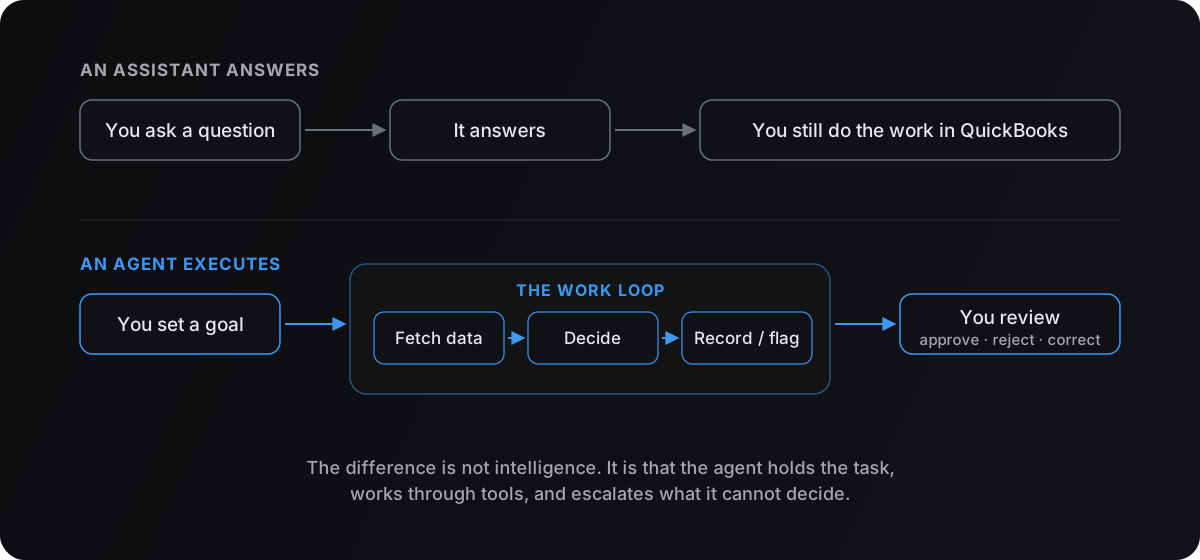
Three things separate the two, and none of them is model intelligence:
Tool access. The agent can act on real systems (read the bank feed, write the journal entry) through structured, permissioned interfaces rather than telling you what to type.
A work loop. It holds the task across many steps, checks its own intermediate results, and keeps going until its task list is empty or it hits something it cannot decide.
Escalation. It knows the boundary of its own confidence and routes exceptions to a person instead of guessing. This is the property that makes the other two safe, and it is the one most often skipped in demos.
The Eighteen Months That Made It Real
The tipping point was not one product launch. It was infrastructure stacking up until agents stopped being demos:
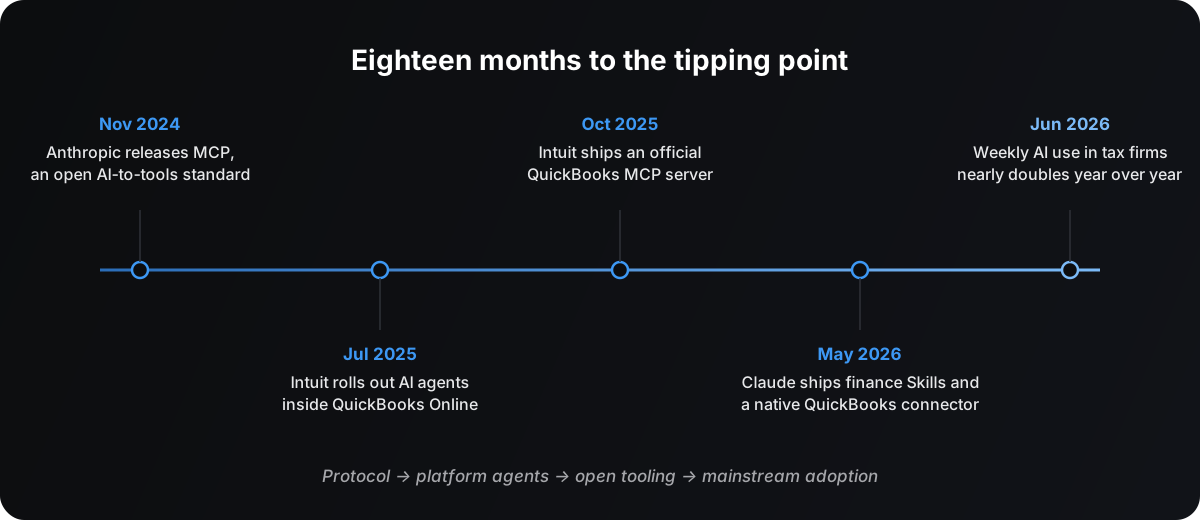
November 2024: the protocol. Anthropic released the Model Context Protocol, an open standard for connecting AI to outside tools. OpenAI adopted it too, which is the quiet, load-bearing fact: for the first time, one integration serves every major assistant.
July 2025: the incumbent moves. Intuit began rolling out AI agents inside QuickBooks Online: payments, accounting, customer agents running proactively for millions of businesses. Whatever you think of embedded, always-on AI (we have a documented position), it normalized the idea of software that acts in the books.
October 2025: the incumbent opens up. Intuit shipped an official open-source QuickBooks MCP server. It runs locally and requires developer credentials, so it is a developer preview rather than a practitioner tool, but it is Intuit itself accepting the open-protocol premise.
May 2026: the assistants specialize. Claude's small-business launch shipped prebuilt finance Skills (invoice chasing, month-end prep, cash forecasting) and a native QuickBooks connector. General-purpose assistants now arrive with accounting workflows in the box.
June 2026: adoption shows up in surveys. A Blue J and CPA.com survey found 60% of tax professionals now use AI for research at least weekly, up from 33% a year earlier. Whatever the caveats about self-reporting, near-doubling in twelve months is the shape of a tipping point.
What the Numbers Show, and What They Don't
The capacity findings are consistent across sources. Karbon's State of AI in Accounting research found firms investing in AI unlocking about seven extra weeks of capacity per employee per year in its 2025 edition; the 2026 edition puts average savings around an hour per employee per day. CPA Trendlines' outlook reports 77% of firms planning to increase AI investment, with 35% already using AI tools daily. And CFO Brew's June coverage of busy season documents the demand side: a real staffing crunch, with very small firms now processing volumes that used to require headcount they could not hire.
Read those numbers with the right caveats. They are survey data, mostly self-reported, some published by vendors with products to sell. The magnitudes will move around. What does not move is the direction: every independent measurement points the same way, and the profession's own capacity math (fewer graduates, more retirements, flat or growing client demand) means the pressure driving adoption is structural, not fashionable.
The more useful question for a firm is not "is the trend real" but "where does the time actually come from." The honest answer: from the work that was always mechanical: transaction categorization, document matching, reconciliation prep, the repetitive core of the close. Not from judgment, and not from review. Which brings us to the part the tipping-point coverage tends to skip.
What Still Breaks
Agentic AI in mid-2026 has real, specific gaps, and pretending otherwise is how firms get burned:
Chat history is not an audit log. A conversation transcript does not tell a reviewer what changed, why, and on whose authority. Any agent that writes to the books needs a structured worklog beside QuickBooks' native audit trail; we have argued this is the standard CPAs should demand, and it remains the sharpest dividing line between tools built for accountants and chat with API access.
Instructions are not enforcement. Most agent "safety" is prompt convention: the model is told to check for duplicates before creating a bill, and it reliably does, but nothing hard stops it. Real guardrails live in the tool layer: no delete operations, scoped OAuth, human approval gating the write. Ask any vendor which of their safeguards are code and which are instructions.
Generic assistants forget, and they don't scale across clients. Out of the box, neither Claude nor ChatGPT holds durable per-client categorization patterns, runs a recurring workflow unattended, or offers a multi-client task list with human approvals. Those capabilities come from the tooling layer around the model. A firm evaluating "AI" is really evaluating that layer; the model underneath is increasingly a commodity, and a very good one.
What a Small Firm Should Do in H2 2026
Not a transformation program. A contained experiment with a measurement attached:
- Pick one client and one workflow. Bank-feed categorization is the standard pilot: high volume, cheap mistakes, easy to score. Note your baseline hours first.
- Define the review gate before the tooling. Decide what the agent may record directly, what always needs approval, and who signs off. If a tool cannot express that boundary, it is not ready for client books.
- Write your policies down. The pilot clients with documented categorization rules are the ones where agents perform, because the agent can follow policy instead of inferring it. Corrections should persist: an agent that repeats March's mistake in April is a demo, not a tool.
- Measure against the baseline, then decide. Hours saved, error rate at review, how quiet the task list gets over time. The ROI framework we published for CPA firms has the full worksheet.
Extension season is the natural pilot window: real deadline pressure, contained scope, and a clean before/after comparison when the Oct 15 crunch hits. A firm that runs the experiment now enters January's busy season knowing exactly what its agent can carry, while firms that waited are still reading tipping-point coverage.
The tipping point, in other words, is not the moment everyone adopts agents. It is the moment the question changed from whether to which workflows, with what review, measured how, and that question is answerable with a four-week pilot.
DeepLedger is an agent layer for QuickBooks Online built around exactly that loop: Claude or ChatGPT doing the work through 26 structured tools, per-client memory, a shared human/AI task list gating every uncertain write, and dual audit trails. The first month is free, no credit card required.
Try DeepLedger with your QuickBooks account or start with how the whole system works.